Why Do I Get Stretch Marks on My Shoulders From Working Out? (And What Actually Fades Them)
Last updated: 21 July 2026
Quick answer
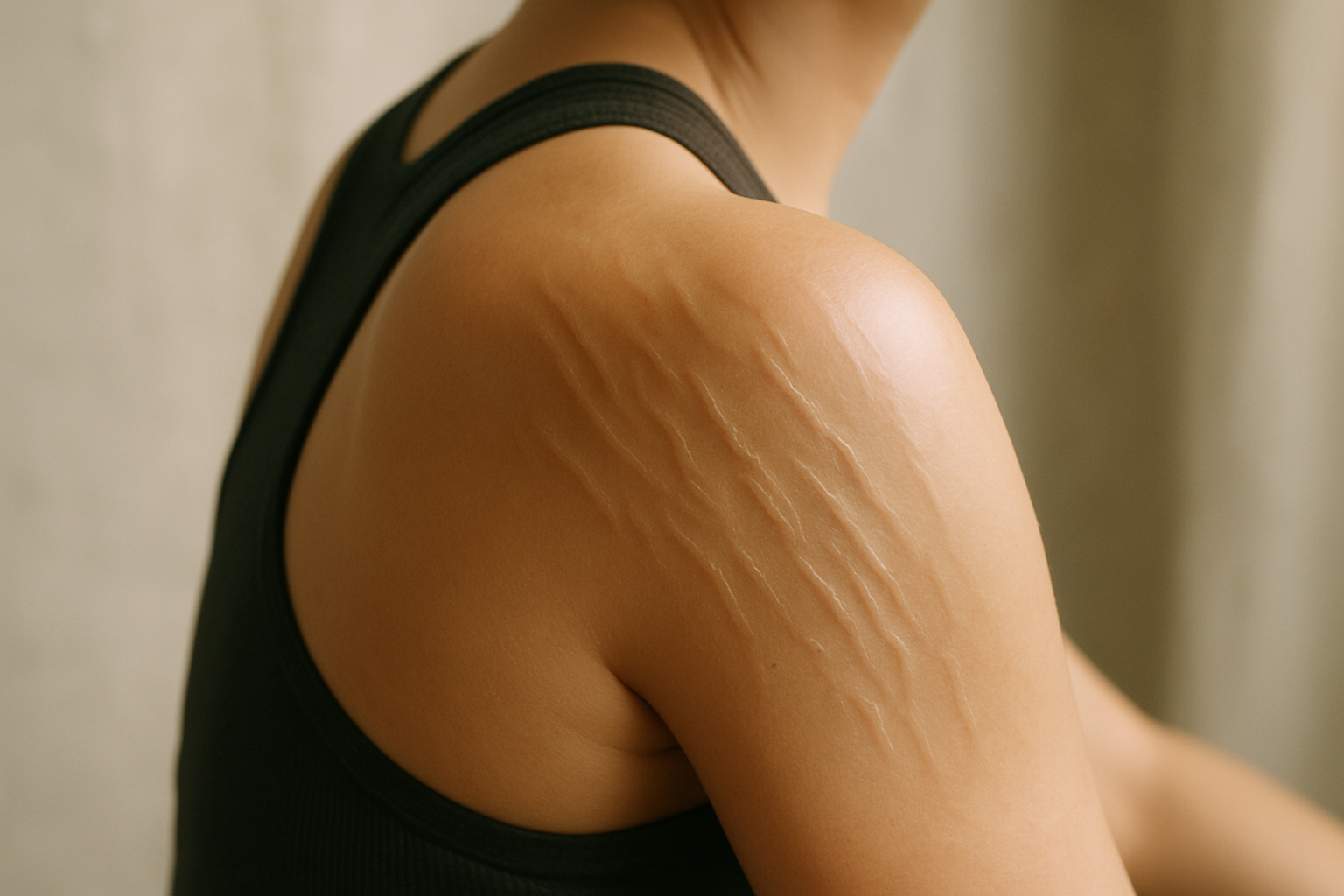
You get stretch marks on your shoulders from working out because muscle grows faster than the skin over it can adapt. When your deltoids, biceps and lats gain size quickly — especially in a hard bulking or beginner-gains phase — the skin is stretched fast enough that the collagen and elastin supporting it rupture, and a stretch mark (medically, striae distensae) forms as the skin heals. The American Academy of Dermatology lists "weight training when you have rapid muscle growth" as one of the main triggers, alongside puberty growth spurts and pregnancy.1 Genetics and hormones decide who gets them — two lifters on the same programme can have completely different skin responses.
They are harmless and extremely common in bodybuilders, and they fade over time from red to silvery-white on their own. Nothing removes them completely, but you can fade the appearance faster by treating them while they are still red or purple with consistent daily massage of a rich, lipid-based product — a water-free botanical concentrate such as ScarDerma Pro is one example built for exactly this newly-stretched skin. See a dermatologist if marks appear without any weight or muscle change, which can occasionally signal something else.
Why lifting gives you stretch marks — the actual mechanism
A stretch mark is a type of scar. The American Academy of Dermatology describes it as skin that stretches or shrinks so quickly that the collagen and elastin supporting it rupture; as the skin heals, the narrow band of a stretch mark appears.1 Cleveland Clinic puts the same mechanism plainly: when skin rapidly stretches, the elastin and collagen in it break, and stretch marks appear in the areas where elastin has torn.2
Weightlifting is a textbook trigger because muscle can grow faster than skin can remodel to cover it. Your skin is elastic, but it has a speed limit. During a strong hypertrophy phase — a beginner's first six months, a dedicated bulk, or a return to training after time off — the deltoids and arms can add measurable circumference in weeks. The dermis underneath simply can't lay down new collagen and elastin at that pace, so it tears microscopically in stiff parallel lines. That is your stretch mark.
Three factors decide whether a given lifter actually develops them:
- Speed of gain. The faster the muscle (or bodyweight) goes on, the less time skin has to adapt. Rapid, aggressive bulks and sudden jumps in training volume are the classic setup. Healthline's guidance on shoulder stretch marks specifically links them to the rapid increase of muscle mass in the shoulders and arms, and recommends steady, gradual progress to lower the risk.3
- Genetics. A family history of stretch marks strongly raises your odds — the AAD notes you're at higher risk if people in your family get them.1 This is why one lifter can gain two stone of muscle line-free while their training partner marks up after a modest bulk.
- Hormones. Fluctuating hormone levels play a role, which is part of why stretch marks cluster in the teenage growth-and-training years and why anabolic steroid use dramatically increases them — the extra hormonal drive plus fast tissue gain overwhelms the skin. Boys Town and Healthline both flag rapid muscle gain from weightlifting, and steroid use in particular, as major contributors.3,4
Where gym stretch marks show up — and why those spots
Most general stretch-mark articles list the belly, hips and thighs and stop there. For lifters the map is different, because the marks follow wherever muscle is growing fastest. Here is where training-related stretch marks actually appear, and the reason each spot is a hotspot.
| Area | Why it's a hotspot for lifters | Typical pattern |
|---|---|---|
| Outer shoulders / deltoids | Delts are one of the fastest-responding muscles to pressing and lateral work; the skin cap over a rounding shoulder stretches quickly. | Short vertical or fanned lines over the side/rear delt |
| Upper arms / biceps | The inner and front upper arm has thinner, more mobile skin; a growing biceps peak tents it outward. | Lines running across the inner upper arm |
| Armpit / lat insertion | As the lats widen, the skin from the armpit down the side is stretched sideways — a very common early-gains site. | Horizontal lines near the armpit fold |
| Chest / pec outer edge | Bench and dip volume builds the pecs fast; skin over the outer and lower pec stretches to follow. | Lines curving under or beside the chest |
| Lower back / flanks | Overall bodyweight gain during a bulk deposits here; the skin is stretched by both muscle and fat. | Angled lines across the lower back |
If marks appear in an area you're not training and haven't gained size, and you've had no weight change, that's worth a dermatologist's eye — occasionally widespread striae without an obvious cause can point to something hormonal.
Red vs white: the single most important thing to know before you treat them
Whether anything you do will fade a gym stretch mark depends almost entirely on how old it is. Dermatologists split stretch marks into two stages, and the treatable window is the early one. The AAD is explicit: creams and other topicals should be used on early stretch marks, because treatment "seems to have little effect on mature stretch marks."1
| Stage | How it looks | Typical age | How responsive it is | Best action |
|---|---|---|---|---|
| Striae rubrae (early) | Red, pink, purple or reddish-brown; may feel slightly raised, sometimes itchy | 0–6 months | Most responsive — this is the window | Daily massage with a rich lipid product; start now, be consistent for weeks |
| Striae albae (mature) | Silvery-white, slightly sunken; you can feel a slight dip running a finger over it | 12+ months | Least responsive to topicals | In-office procedures (laser, microneedling, radiofrequency) have the most evidence; keep skin hydrated |
The practical takeaway for lifters: the marks you notice mid-bulk, while they're still angry and red, are the ones you can most influence. Waiting until they've turned silver is waiting until the easiest window has closed.
Can you prevent stretch marks while still building muscle?
Partly. You can't guarantee stretch-mark-free gains — genetics has the final say — but you can lower the odds by removing the "too fast, too dry" conditions that trigger them.
- Grow at a controlled pace. The prevention advice that keeps coming up from dermatology sources is steady, gradual progress rather than sprinting from point A to point B. Healthline recommends choosing a routine built for steady progress and avoiding sudden weight gain, precisely because slow gain gives skin time to keep up.3 A lean-bulk pace of roughly 0.25–0.5 kg of bodyweight a month is far kinder to skin than an aggressive dirty bulk.
- Don't use anabolic steroids to force it. Steroids are one of the strongest amplifiers of stretch marks, because they add hormonal skin-thinning on top of unnaturally fast tissue gain. Healthline calls this out directly as a cause to avoid.3
- Keep skin hydrated and well-fed. Well-hydrated, nutrient-supported skin is more pliable. Cleveland Clinic points to hydration plus a diet with adequate protein, zinc and vitamins A, C and D, and notes that research on ingredients like centella and hyaluronic acid is more promising for prevention than the cocoa-butter myths.2 The AAD agrees that centella- or hyaluronic-acid-containing products may help prevent striae, while almond oil, cocoa butter, olive oil and vitamin E did not in studies.1
- Skip the myths. Tanning doesn't fade stretch marks — it makes them more obvious, because scar tissue doesn't tan. And cocoa butter, coconut oil and plain vitamin E have repeatedly failed in controlled studies. A self-tanner can camouflage marks but won't remove them.1
The routine that fades gym stretch marks fastest
Nothing erases a stretch mark — like any scar, they're permanent, though their appearance improves a lot with the right care and time.1 This sequence targets the two things you can actually change: how hydrated the skin is, and how consistently you work the product into an early mark.
- Start while they're red. The single biggest lever is timing. Begin caring for the marks during the striae rubrae stage, not once they've gone silver.1
- Apply to damp skin after showering. Put your product on within a couple of minutes of getting out, while skin is still slightly damp, to lock moisture into the thin stretched band.
- Massage it in for two minutes per area. The AAD notes that taking time to massage a product gently into the skin may make it more effective — and a review of moisturisers on scars and striae found regular emollient massage can improve how the marks look and feel.1,5 Circular massage over the delt or upper arm takes seconds and doubles as post-session recovery.
- Twice a day, every day, for weeks. Results appear over weeks, not days, and only with consistency. Sporadic use does almost nothing.1
- For old, white marks, consider a dermatologist. If your marks are already mature, in-office procedures such as laser therapy, microneedling and radiofrequency have more evidence than any cream, and a board-certified dermatologist can tell you what suits your skin.1,6
Why a water-free lipid suits newly-stretched gym skin
Most stretch-mark lotions are mostly water. On the thin, tight skin of a fresh mark, that water evaporates and can leave the surface feeling drier than before. A water-free (anhydrous) lipid concentrate does the opposite — it's all active botanical lipids, so it saturates the dry stratum corneum and stays put through the two-minute massage dermatologists recommend. That's the design idea behind ScarDerma Pro, below.
ScarDerma Pro — a lipid concentrate for newly-stretched skin
ScarDerma Pro is a 100% water-free botanical lipid concentrate formulated to move into the surface layers of the skin and support the smoother, softer, more even-looking appearance of scars and stretch marks — rather than sitting on top like a silicone patch or evaporating like a water-based cream. Because it's anhydrous, it's preservative-free by design and free from harsh acids, drying agents, and artificial fragrance, which suits the sensitive skin of a fresh mark.
Its blend leads with botanicals long studied in skin care: rosehip seed, a natural source of trans-retinoic acid (sometimes called "natural tretinoin") that small studies link to a modest improvement in the look of texture and marks;7 pomegranate seed, whose extract has been shown to encourage keratinocyte (skin-cell) renewal in laboratory research;8 plus immortelle helichrysum and tamanu in a lipid base of sea buckthorn, calendula and jojoba.
ScarDerma Pro was developed by formulator S. C. Aris, carries a real customer rating of 5.0 / 5 from 62 reviews, and is backed by a 90-day money-back guarantee — so you can try it on early marks over the several weeks it takes to judge results. It fits neatly into a post-workout routine as a two-minute massage over the areas that mark.
ScarDerma Pro is a cosmetic product intended to support the appearance and feel of skin. It is not a medicine and does not treat, cure, or prevent any condition. If marks appear without a weight or muscle change, see a doctor.
Frequently asked questions
Are stretch marks from working out permanent?
Like any scar, yes — they don't fully disappear. But they fade naturally from red to silvery-white over time, and caring for them early with consistent massage can make them noticeably less visible.
Do stretch marks mean I'm building muscle too fast?
Often, yes — rapid muscle or bodyweight gain is a classic trigger, which is why aggressive bulks and beginner-gains phases mark people up. Growing at a steadier pace gives skin more time to adapt and lowers the odds, though genetics still has the final say.
Can men get rid of stretch marks on their shoulders?
You can fade their appearance, especially while they're still red, with daily hydration and massage. Mature white marks respond less to creams; in-office dermatology procedures have the most evidence for those.
Will building muscle more slowly stop new stretch marks?
It can lower the risk. Steady, gradual gain and good skin hydration give the dermis time to remodel, but people with a family history may still get some marks regardless of pace.
Does ScarDerma Pro remove stretch marks?
No product removes a stretch mark. ScarDerma Pro is a cosmetic formula that supports the smoother, more even-looking appearance of marks when massaged in daily — best used on early, red marks.
When gym stretch marks are worth a doctor's opinion
Stretch marks from training are harmless and need no medical treatment. But see a dermatologist if striae appear widely without any weight gain, muscle gain or growth spurt to explain them, if you develop lots of marks rapidly alongside other symptoms, or if you've been using topical or oral steroids. In those cases the marks can occasionally be a clue to a hormonal cause such as Cushing's syndrome, which the AAD and Cleveland Clinic both list among the non-training reasons striae form.1,2 A dermatologist can also walk you through the in-office options for older marks.
Related reading
- Stretch Mark Treatment: Prevention, Causes & What Works
- Why Do My Stretch Marks Itch When I'm Losing Weight?
- Why Is My Scar Still Red — and How Long Does Redness Last?
- Do Old Scars Ever Fade?
- How to Soften Old Hard Scar Tissue
References
- American Academy of Dermatology. "Stretch marks: Why they appear and how to get rid of them." aad.org
- Cleveland Clinic. "Stretch Marks: What Are They, Causes & Treatments." my.clevelandclinic.org
- Healthline. "Are Stretch Marks on Shoulders Normal? Causes and Prevention." Medically reviewed by Cynthia Cobb, DNP. healthline.com
- Boys Town National Research Hospital. "Stretch Marks." boystownhospital.org
- Rawlings AV, Bielfeldt S, Lombard KJ. "A review of the effects of moisturizers on the appearance of scars and striae." Int J Cosmet Sci. 2012;34(6):519–524. PubMed 22994859
- Mikes BA, Oakley AM, Patel BC. "Striae Distensae." StatPearls, updated 2025. NCBI Bookshelf NBK436005
- Ud-Din S, McGeorge D, Bayat A. "Topical management of striae distensae (stretch marks): prevention and therapy of striae rubrae and albae." J Eur Acad Dermatol Venereol. 2016;30(2):211–222. PubMed 26486318
- Aslam MN, Lansky EP, Varani J. "Pomegranate as a cosmeceutical source: pomegranate fractions promote proliferation and procollagen synthesis…" J Ethnopharmacol. 2006;103(3):311–318. ScienceDirect